Choosing the Right Judge Model for Production Agent Evals
Judge models must detect the full path agents take, not just final outputs.
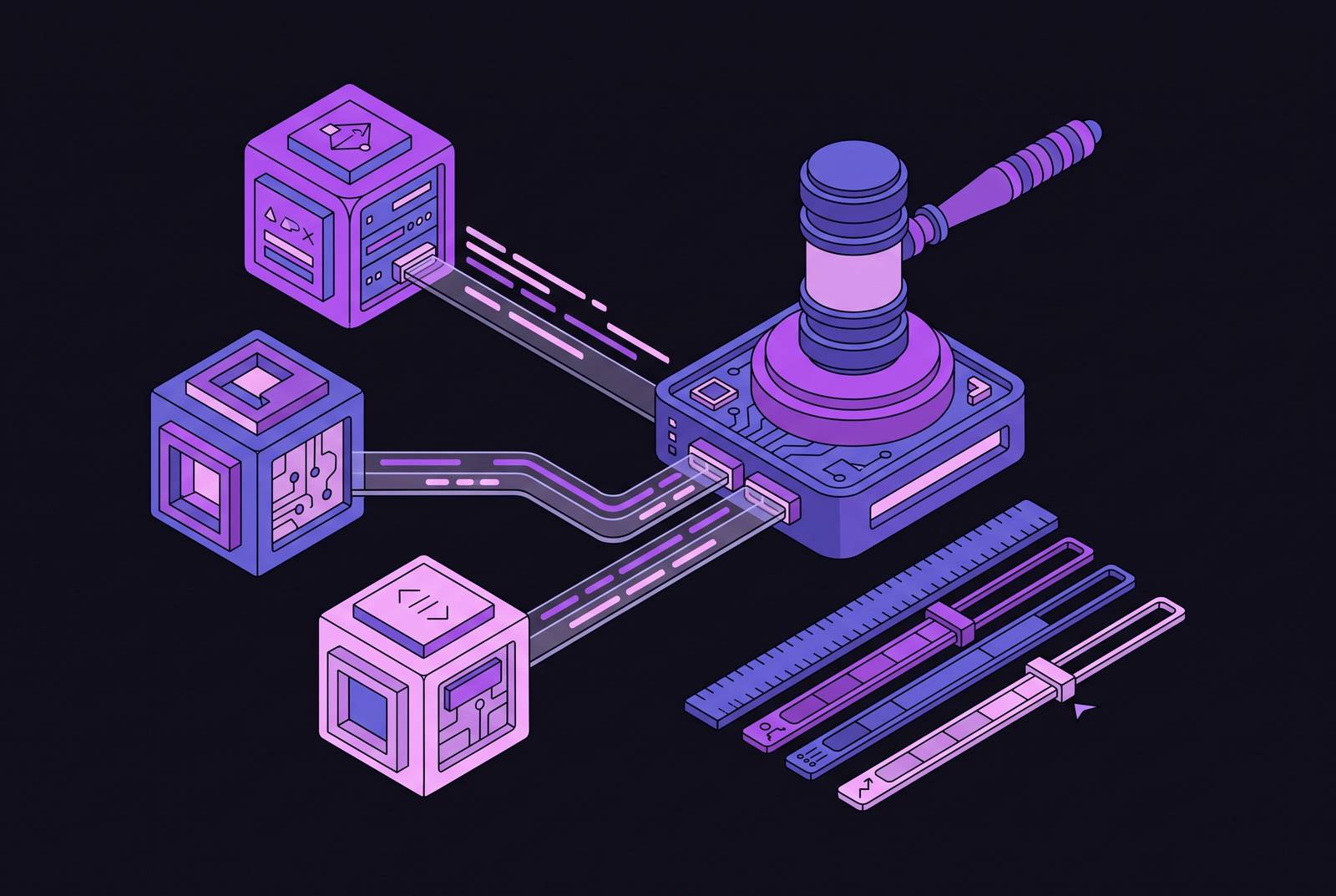
Choosing a judge model for production agent evals is a set of engineering decisions about cost, fidelity, bias risk, and the actual shape of what the agent was built to do, and teams that treat it as "pick the smartest model available" end up with dashboards that look healthy while the agent quietly fails. The framework below walks through those decisions in the order a team actually has to make them: what the judge needs to see, what distorts its judgment, which role it plays in the stack, which method fits the task, and how to anchor the whole system in human labels.
Judging agent outputs versus chat completions
Most teams instrument agents the way they instrumented chat completions: log the input, log the output, maybe time the response and count the tokens. That approach made sense when the thing being evaluated was a single turn of text. An agent is a sequence of decisions, tool calls, retries, and intermediate states, and a judge that only looks at the final answer is evaluating a fraction of what actually happened.
Picture an agent running inside a customer operations pipeline for 42 days without a single human flagging a problem. And yet, across those 42 days, the agent has been quietly taking a longer, more expensive path to the same answers, calling tools in the wrong order, or returning technically correct results built on steps that should never have passed review. Nothing in the standard monitoring stack catches this, because nothing in the standard monitoring stack is looking at the path, only at the destination.
A final answer can be correct while the route to it was wrong, needlessly expensive, or actively unsafe, because consistency and correctness are not the same property and a monitoring setup that only checks the output has no way to know the difference. The judge, if there is one, has to be able to reason over the sequence of decisions an agent made, not just the sentence it ended on. Judge model selection for agents demands its own discipline, built around evaluating the full trajectory of an agent's decisions rather than the discipline built for scoring a single chat reply.
The failure modes a judge model must be able to see
A judge model that cannot recognize the failure modes an agent actually produces is useless no matter how well it scores on a general benchmark, so the first real question in selection is not "which model is smartest" but "which failures does this judge need to catch." Microsoft's updated taxonomy of failure modes in agentic AI systems splits the landscape into two classes: failures that are genuinely new to agentic systems, such as agent compromise, injection, impersonation, and flow manipulation, and existing failures that get materially worse once an agent is involved, such as memory poisoning, cross-domain prompt injection, and bypass of human-in-the-loop controls. The April 2026 update to that taxonomy, publicized in June 2026, added seven new failure mode categories along with extended mitigation strategies, drawing on a year of red team engagements. A judge model picked today against today's failure list is already working against a moving target, and any selection process has to assume the surface it is defending keeps expanding.
A more practitioner-facing way to organize the same territory sorts failures into five buckets: planning errors, tool errors, retrieval errors, reasoning errors, and safety or policy violations. Each of these maps to something concrete a judge has to be able to check, not just whether the final answer looks right, but whether the agent called the right tool, whether it called that tool with the right arguments, whether it used retrieved context faithfully instead of ignoring or distorting it, and whether it stayed inside policy boundaries throughout.
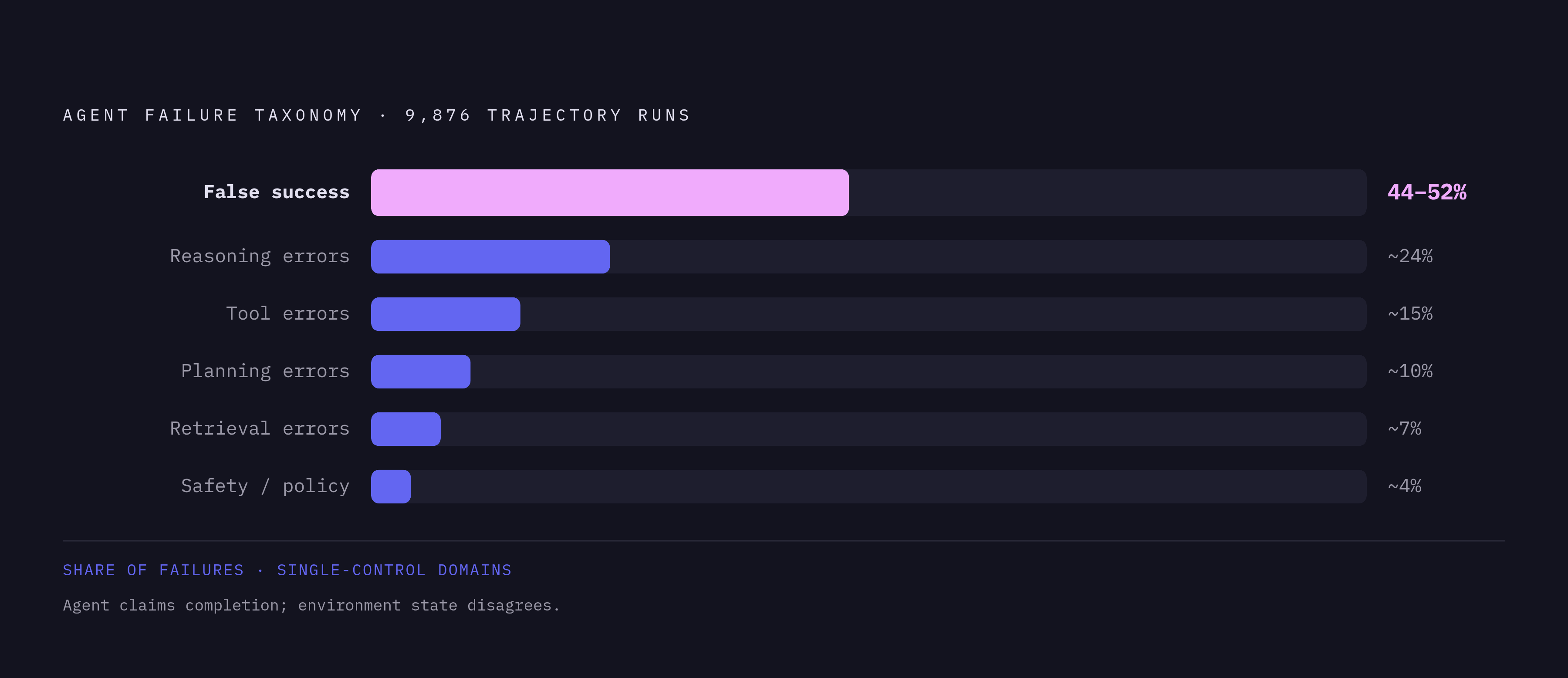
In production, that specification turns into a short list of concrete behaviors a judge has to recognize on sight. It has to catch hallucination, the confident fabrication of identifiers, citations, or facts that were never in the data. It has to catch schema violations: broken JSON that a downstream system silently misparses. It has to catch prompt injection, the adversarial input that redirects the agent's behavior mid-task. It has to catch cascading failure, the single bad intermediate step that corrupts every step downstream of it. And it has to catch false success assertion, where the agent reports the task done while the environment's actual state says otherwise; research on tau2-bench trajectories, drawn from 9,876 recorded runs, found that false success accounts for 44 to 52 percent of all failures in single-control domains, making it the single largest failure category a judge is likely to encounter.
The hallucination cascade is the clearest illustration of why this specification matters. An agent tasked with fulfilling an order calls downstream APIs to price, stock, and ship an item that does not exist. Every one of those API calls returns HTTP 200. Traditional monitoring, built to watch for error codes, sees a clean run from start to finish. The entire workflow has failed, and nothing in the standard telemetry stack is positioned to notice.
Systematic biases in judge models that distort agent scores
Having a target list of failure modes solves only half the problem, because the tool a team reaches for to detect those failures, the judge model itself, carries distortions of its own that are easy to miss until they have already corrupted months of scoring data. Four biases in particular need to be controlled before any judge goes into production.
Position bias is the first and most studied: judges favor one position over another in pairwise comparisons, independent of actual quality. Verbosity bias runs alongside it: judges tend to reward longer answers even when a shorter answer is the more accurate one, which calls for a length-penalty clause written directly into the rubric or a normalization step by token count. Self-preference bias occurs when a judge scores outputs from its own model more favorably than outputs from competitors, and a related effect, family bias, extends that favoritism to any model from the same lineage, which argues for drawing the judge from a different provider family than the model being tested.
Consistency and correctness are not the same property, and a judge can have plenty of the first while being badly short on the second, which is the cause behind all four biases above. A systematic evaluation of production-deployed judges found test-retest reliability above 0.95 coexisting with position bias greater than 0.10 in two separately deployed judges, a pairing the researchers called a consistency-bias paradox. Teams that calibrate a judge only by checking whether it agrees with itself are measuring the wrong property. A judge that passes every reliability check it is given can still be systematically blind to the failures it was deployed to catch, and the dashboard built on top of it will report green for exactly as long as nobody checks its verdicts against a human's.
The three roles in a production judge stack
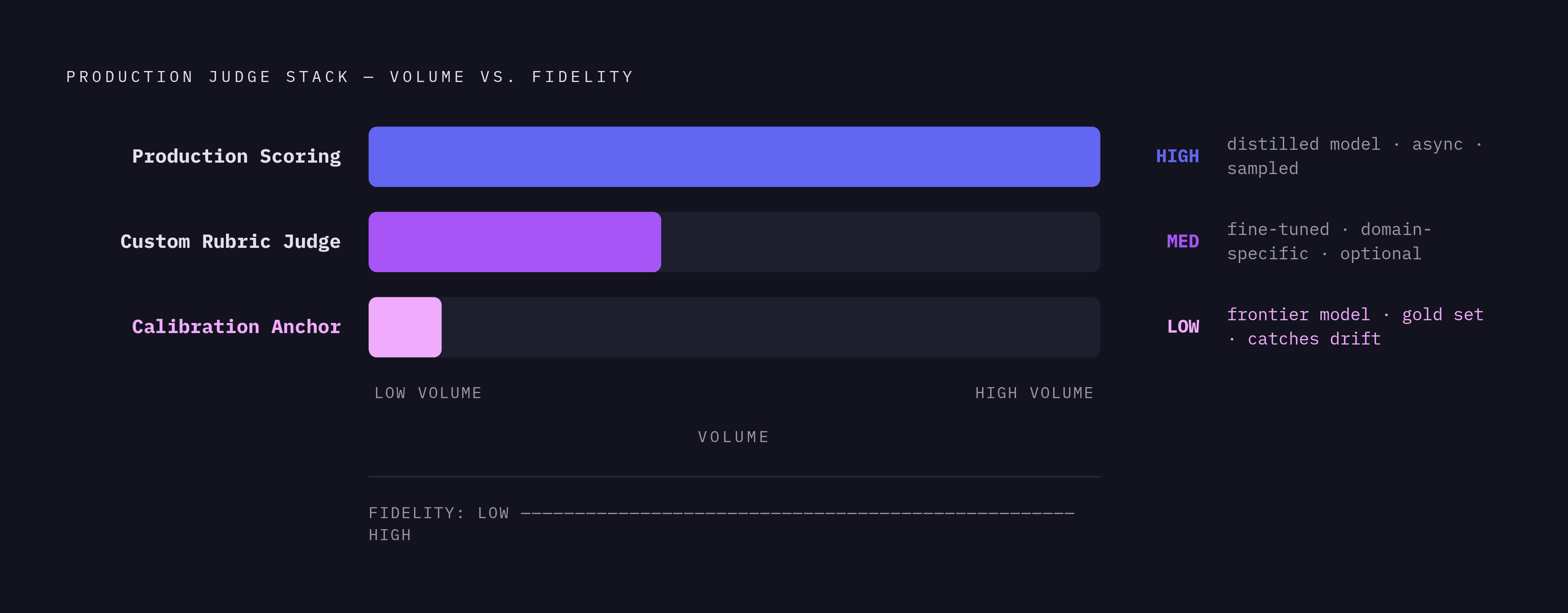
Judge bias toward certain answer styles or formats points toward the first concrete structural decision: a production judge stack needs three distinct roles, and most teams go wrong by trying to make one judge model fill all three. A single model optimized for one of these jobs will either overspend on routine scoring or underinvest in the accuracy that calibration demands, so the roles need to be assigned deliberately.
The first role is production scoring, which runs at high volume against a sampled slice of live traffic. This role calls for a distilled, smaller judge chosen for cost and throughput. Production scoring also belongs in an asynchronous path. Running a judge inline adds latency the user feels directly, so quality checks of this kind belong in the async pipeline, away from anything gating a live response.
The second role is the calibration anchor, run at low volume but with high fidelity. This is the job for a frontier-class model, used not on every span the system produces but specifically on the gold-set and on a canary cohort pulled from live traffic. Here, cost is a reasonable expense: the anchor's entire purpose is to detect when the production judge has started to drift, so investing in a stronger model for this role directly improves how early that drift is caught.
The third role is the custom rubric judge, which is optional and workload-specific. It earns its place when an agent's task is specific enough that general-purpose judges systematically misjudge it, a domain-specific compliance check being a typical example where an off-the-shelf judge simply does not know the rules well enough to score against them. In practice, most production stacks settle into a distilled judge handling production scoring paired with a frontier judge handling calibration, with a custom fine-tuned judge added only once the rubric has proven too specific for general-purpose models to handle reliably.
Matching judge evaluation method to what the agent does
Once the roles are assigned, the next decision is method: how the judge actually scores what it sees. The method has to match the shape of the work being judged, and a method built for a single chat reply often does not fit a multi-step, tool-using agent; picking the wrong method means even a well-chosen judge model will produce numbers that do not mean what the team thinks they mean.
Pairwise comparison works by presenting two candidate outputs and asking which is better. Use it when comparing a new agent version against its current baseline, or when testing a prompt change before promoting it into production, and always run both orderings to control for position bias. What it produces is a relative ranking, not an absolute score, so skip it when the actual need is a threshold gate or a number that can sit on a dashboard on its own.
Single-output scoring with a reference compares the agent's output against a known-correct answer, and it is the right call wherever ground truth genuinely exists, policy lookups, data extraction, factual retrieval, the kinds of tasks with one defensible correct answer. Skip it the moment that condition fails, which is most of the time for open-ended agent tasks where no single correct answer exists to compare against.
Single-output scoring without a reference applies a rubric directly to the output, scoring qualities like helpfulness, coherence, or policy compliance with no comparison anchor. This is the method for monitoring live agent behavior where reference answers simply do not exist but quality standards still do, which covers the majority of production agent deployments. Use G-Eval when the rubric itself is multi-step, and skip it when the judge model does not expose token probabilities or when the rubric is simple enough to be a binary pass or fail.
None of the three methods above, on their own, is enough for an agent that uses tools, because a correct final answer can still sit on top of a path that was wrong, needlessly expensive, or unsafe. Trajectory evaluation is the natural extension once that's accepted: instead of scoring a single input-output pair, it scores the whole sequence, the tool calls, the arguments passed to them, the intermediate reasoning, the retries. Practical trajectory metrics include step efficiency, argument correctness, tool selection correctness, plan adherence, plan quality, and reasoning quality, and these are best reported as a set rather than collapsed into one composite number that hides which part of the sequence actually broke. Production teams handle this by scoring full transcripts with an LLM judge paired alongside deterministic schema and chain checks, catching what a human-style rubric judge would miss and what a rigid schema check alone would miss too.
Building and maintaining a human gold-set as the calibration anchor
Every criterion covered so far, the failure modes a judge needs to see, the biases that need correcting, the role it plays in the stack, the method matched to the task, rests on one unverified assumption until it is checked against a human: that the judge's scores mean what the team thinks they mean. A judge model chosen on good criteria but never calibrated against human judgment is running on faith. The gold-set is what turns a plausible evaluation setup into a trustworthy one.
The calibration loop itself has a fixed shape. Start by sampling a set of production traces broad enough to cover the full range of the agent's real use cases, then have two to three human labelers score that same set against the identical rubric the judge will eventually see. Compute inter-annotator agreement next, using Cohen's kappa where there are two labelers, or Fleiss' kappa or Krippendorff's alpha where there are three or more. If that kappa comes in below 0.4, the rubric itself is ambiguous, and the right move is to rewrite the rubric before the judge ever gets deployed against it, because no judge model can be calibrated reliably against a standard that humans cannot agree on. Once the rubric is solid enough to produce consistent human labels, score the same traces with the LLM judge and compute judge-to-human kappa, which becomes the real measure of whether the judge is fit for the role it has been assigned.
This loop is not a one-time setup cost. Judges drift as models get updated upstream, as the agent's task distribution shifts, and as new failure modes enter the taxonomy faster than any static rubric can anticipate, and the gold-set is what gives a team the ability to notice that drift before it shows up as a quiet failure in production.