Conventional Observability Instruments the Witness Stand Not the Deliberation Room
Agent traces show what happened, not whether it was right.
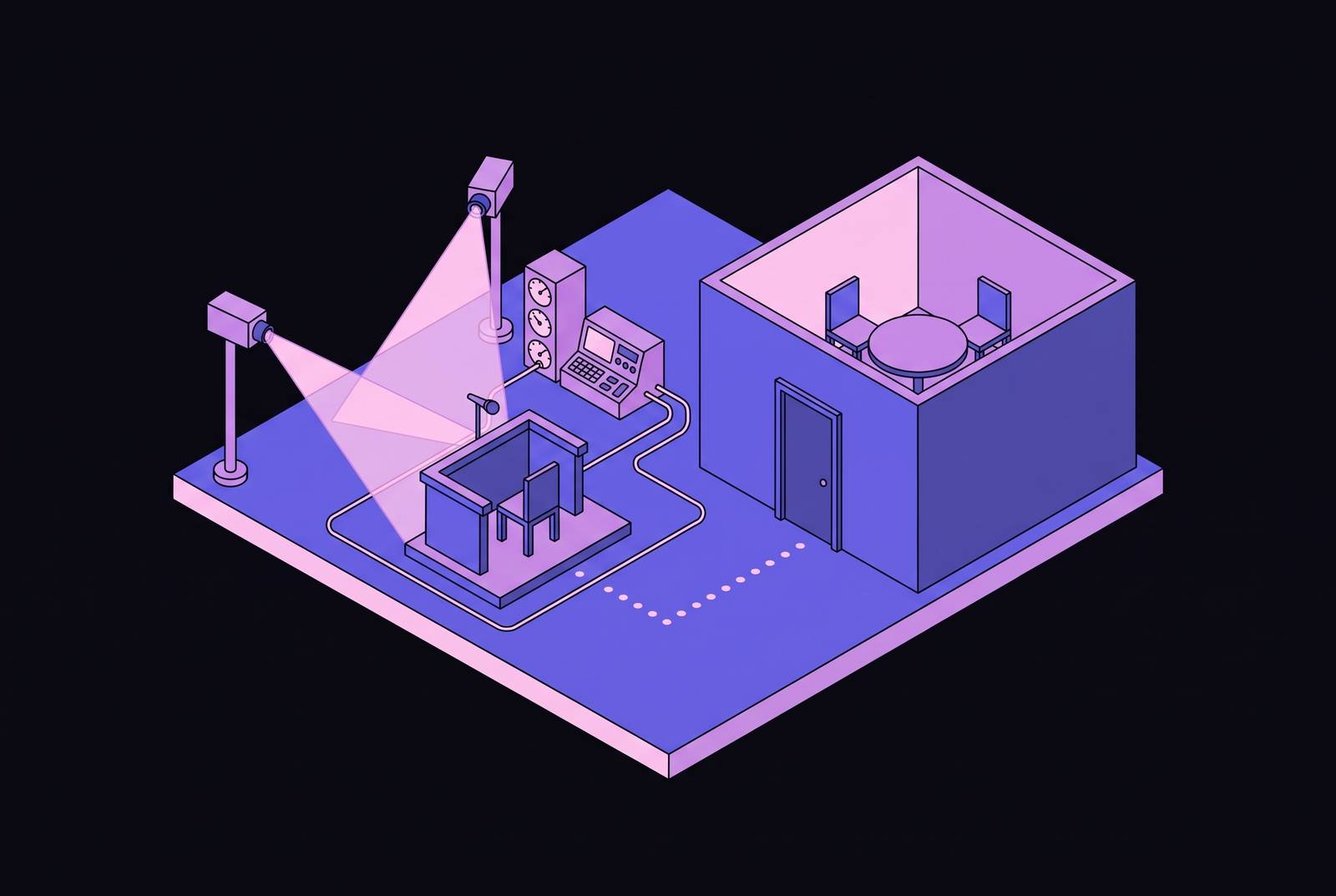
Traditional error monitoring fails for AI agents because a run that finishes without errors does not prove that the result is right. An agent can complete every tool call, return a response, and meet latency targets while violating the user’s intent. Conventional observability instruments the witness stand. For agents to be reliable in production, teams need semantic judgment of the recorded actions, then fixes that become regression evaluations.
Why recording an agent's actions is not the same as judging them
The witness stand records testimony faithfully and completely, yet juries still deliberate because recording facts and rendering verdicts are different acts. Conventional observability serves the first function. It captures events, sequences, and timings, answering what happened across a system’s execution. Agents raise a second question: whether what happened was correct. That question requires a standard against which the recorded actions can be judged.
The distinction is structural. A trace can establish that an agent invoked a tool with particular arguments and received a result. It cannot, by recording those facts alone, establish that the action served the intended goal. Correctness is a semantic property of the action in context. More complete testimony does not remove the need for judgment.
Why does an LLM agent look fine in logs but still give bad outputs?
Tool calls finish, workflows return responses, and traces show green even when the result is wrong. Six failure modes illustrate this gap, including tool misuse, context loss, goal drift, retry loops, cascading errors in multi-agent systems, and silent quality degradation. Their shared feature is a mismatch between what the recorded execution accomplished and what the task required.
Tool misuse can begin with a single malformed argument at step two that silently corrupts downstream steps dependent on its output. The trace shows that the call succeeded, even though later work relied on the wrong result from that call. Goal drift is different. Each turn can look locally coherent while small deviations accumulate into an answer that no longer serves the original intent. Context loss similarly produces a response that looks reasonable in isolation but is wrong relative to earlier information, which a per-span metric does not evaluate.
The Cursor support agent fabricated a multi-device login policy in April 2025. The Replit coding tool wiped a database in July 2025 without throwing a system error. Both completions were structurally successful and semantically catastrophic. Latency and error monitoring could not distinguish those outcomes from acceptable execution.
What evaluation blindness means as a formal property, not a metaphor
Evaluation Blindness: How Silent Measurement Failures Corrupt AI Systems from Training to Deployment defines the problem as a property of measurement. A measurement function exhibits evaluation blindness with respect to a failure class if it produces a value indistinguishable from a non-failing state while the system is failing, and no auxiliary signal flags the discrepancy. This definition makes the boundary precise.
The paper shows this boundary through the case of the Air Canada chatbot. The output passed the integration pipeline’s implicit quality checks because no part of the pipeline checked the chatbot’s claims against a live policy database. The measurement function could not distinguish a correct policy statement from a fabricated one. Changing the amount of execution data would not supply the absent comparison against policy.
The same paper identifies an operational failure class, including silent quality degradation, that is entirely silent by its structural definition, and tests that classification against production incidents. It also describes how accuracy can remain stable across evaluation windows while output diversity collapses by a large factor. The number remains reassuring because it measures only accuracy, so evaluation blindness is a structural problem. Adding spans to a measurement function that cannot distinguish the failure produces more blind measurements.
What the witness stand does capture, and why that coverage still matters
Conventional observability nevertheless solves a difficult and necessary problem. Distributed execution across model invocations, tool calls, retrieval steps, and external APIs is hard to reconstruct after the fact. Traces preserve the relationships needed to follow that execution. Without them, teams may see that the result is wrong but be unable to tell what caused it. Semantic evaluation needs this record as evidence, though the record cannot judge itself.
The OpenTelemetry GenAI standard defines agent-specific span operation types, including create_agent, invoke_agent, invoke_workflow, plan, and execute_tool. These provide a substrate for capturing what an agent did and in what order. Argument-level tracing sharpens the diagnosis further. Without it, someone investigating a failure cannot tell a bad plan from a bad tool call, even though each needs a different fix.
The MAST taxonomy from UC Berkeley and Intesa Sanpaolo, presented at NeurIPS 2025, built its failure classification from annotated execution traces. That method gives tracing its proper role. The execution record made it possible to work out why things failed, while annotation added judgments about what the events meant. The witness stand is a prerequisite for deliberation.
Why the gap widens specifically when agents run multi-step workflows in production
A single-turn LLM response can be read and judged directly. A multi-step workflow cannot be assessed as reliably through its final response, because that response may look correct after intermediate steps have corrupted the trajectory. The earlier wrong argument may be hard to find among calls that completed. Inspecting the final answer therefore removes precisely the context needed to explain how it was produced. As the agent’s scope of action grows, its actions become harder to inspect.
The MAST annotations show that task-verification failures account for a substantial share of observed failures, as does step repetition. Those verification failures include verification that is wrong, missing, or incomplete, and stopping too soon. They need not be visible in the final output. Outcome Monitors: Recovery Affordances for Silent Tool Failures demonstrates a related mechanism in which an agent consumes a cached HTTP error page as content and treats it as fact. Standard monitoring leaves the silent failure undetected while subsequent work proceeds from that result.
Sierra’s tau-bench pass^k metric distinguishes success on one attempt from consistent success across independent attempts on the same task. A successful demonstration answers only the first question. The distinction becomes more pronounced as tasks grow complex, because production reliability depends on repeatable completion. The reliability framework cited in the research evaluated 23,392 episodes across four task durations and found that capability and reliability diverge systematically as duration increases. It also found existing benchmarks structurally blind to that divergence, limiting what pre-deployment confidence establishes about longer production workflows.
What outcome contracts and semantic checks add that spans cannot express
The architecture needs added checks that judge whether results have the expected relationships, alongside the record of when they arrived. The Outcome Monitors paper calls these properties “outcome contracts.” They are invariants mined from nominal executions or derived from public schemas that specify relationships between tool calls and their results. The monitor checks the returned result against the contract. This changes the object of evaluation from successful execution to an expected property of its outcome.
A schema check establishes that a call has the right shape. It does not establish the right meaning. A refund in the right format but sent to the wrong customer can pass type checks even though it fails the task. An outcome contract can instead check the relationship between the retrieved customer ID and the order ID. The identifiers may already appear in the trace, but their presence is not the same as evaluating whether their relationship is valid.
The paper also shows why detection needs an actionable response. When a contract violation was detected and the agent received a recovery affordance consisting of available recovery tools, task completion reached 28.1% across four models on ToolMaze, against a baseline well below that. When the recovery-tool list was removed, the gain disappeared entirely. The result supports a specific requirement for this layer. It must both flag that the returned result broke an expectation and give the agent a way to recover.
How online evaluation of production traffic closes the loop that static tracing leaves open
Per-call contracts address particular violations, but production behavior also changes over time. Offline evaluation tests an agent against a static dataset before deployment. It cannot detect drift that comes later when production traffic changes, model providers make updates, or prompts change. The test preceded the changed conditions. Continuous evaluation is needed to judge how the agent behaves for users as those conditions change.
Online evaluation uses live production traces as inputs to semantic judgment. The LangChain State of AI Agents Report 2025 found that, of all teams, only 37% run online production evaluations. That leaves a substantial separation between recording production behavior and judging it. An interaction can be kept for review without ever being scored against the agent’s instructions or what it was meant to achieve.
The practical division of labor is between deterministic checks and LLM-as-judge scoring. Fast invariant checks on every interaction catch structural violations, while semantic scoring on a sample detects quality drift that those invariants cannot express. Prompt drift illustrates the need for that second layer. In the scenario described in the research, agents begin failing inconsistently three days after a model provider update, with gradual deterioration. A semantic judge comparing outputs against the agent’s instructions over time makes that change visible.
To turn those judgments into operational work, recurring failures need to be grouped into issues rather than presented only as individual trace anomalies. When teams review every flagged trace, they have to look into each case on its own. A named failure type with a count of recent occurrences instead gives the team a recurring behavior to investigate. The trace remains available as diagnostic evidence. Its role shifts from an isolated alert to an example of a problem that can be fixed.
Connecting the fix back to where engineers already work through MCP, coding agents, and regression evals
Detection and diagnosis become a closed loop only when they lead to a change and a check that the change holds. Coding agents operating via MCP can receive the diagnostic context, including the trace, the failure group, the violated contract, and the agent’s own instructions. They can then propose a prompt or logic change without requiring an engineer to reconstruct the failure from raw logs. The context makes the proposal specific. It connects the observed behavior to the requirement that behavior violated.
A well-scoped MCP server can provide both the relevant repository context and the failure’s trace data. That is structurally different from asking a coding agent to “be careful.” A general warning does not identify the failed relationship or the logic involved. The diagnostic record shows what the proposed fix needs to address, while repository context shows where that target sits in the code or instructions that can be changed. MCP provides the connection, but the specificity of the evidence makes the work actionable.
Verification then turns the production failure into a regression evaluation automatically. Once a fix ships, the failure that triggered diagnosis becomes a check against recurrence. In that arrangement, the trace supplies evidence, the semantic check judges it, and the proposed change addresses the diagnosed cause. The production evaluation completes the loop by testing whether the corrected behavior holds, so the same regression cannot return silently.