Human-in-the-Loop Review Workflows for Judge Disagreements
Route disagreements to reviewers while auto-approving consensus cases.

Disagreement is a routing signal. The practical goal is to send contested outputs to reviewers who can resolve them, return those decisions to judge calibration, and keep clear-cut cases moving through the automated pipeline.
Why judge disagreements are a routing signal, not evaluation noise
When two automated judges score the same output differently, their divergence identifies a question that automated scoring has not settled. Averaging their scores may produce a convenient result, but it removes the distinction between an ambiguous output and one that both judges assessed confidently.
Disagreement therefore changes the purpose of evaluation. Instead of forcing every output into a final automated verdict, the system can identify where human judgment could change the outcome. Kili Technology's oversight guide frames evaluation as an ongoing prediction about future system behavior. Contested cases contribute evidence to that prediction by exposing uncertainty that a single aggregate score would conceal.
A pipeline that routes disagreements to humans while resolving clear-cut cases automatically concentrates expert attention where it has a purpose. However, a disagreement flag does not yet explain why the judges diverged. Efficient routing begins by separating uncertainty about an output from a defect in the judges themselves.
What makes an output genuinely contested versus consistently misjudged
Stochastic disagreement concerns an output that reasonable evaluators could assess differently. Judges that use different rubrics may disagree because the output can be read in more than one way. Human review can resolve the case by applying judgment to that ambiguity. The disputed object is the output itself.
Systematic disagreement has a different source and remedy. One judge may keep favoring a response because of position bias, length preference, or same-family circularity. In that situation, adjudicating individual outputs does not remove the directional bias that produced the disagreement. The intervention belongs in the rubric or judge architecture.
Inter-judge variance helps distinguish these problems across a cohort. Running two different judges on the same outputs reveals whether divergence is isolated or widespread. High variance signals an unstable rubric that needs attention at the rubric level, while low variance with known systematic bias points to an architecture problem.
For workflow design, this distinction determines the destination of the signal. Human review resolves case-specific ambiguity, while cohort-level patterns inform changes to the evaluation system. A workflow that treats both as annotation tasks spends reviewer time without necessarily correcting the cause.
The three oversight postures and which one disagreement routing actually requires
Disagreement-triggered review is specifically a human-on-the-loop pattern, even when it sits within a broader human-in-the-loop program. The distinction determines where approval gates belong. Human-in-the-loop requires a person to approve every output before it takes effect. That approach fits high-liability decisions such as loan underwriting or clinical triage, where even one error can be reason enough to require review.
Human-on-the-loop allows the automated pipeline to run while routing flagged outputs to people. Human decisions then feed back into calibration. Kili's guide describes this posture as reserving expert bandwidth for exceptions through defined risk triggers. Judge disagreement provides one such trigger in an evaluation pipeline.
Human-in-command keeps people in charge at every step. That posture is appropriate for clinical diagnostics or autonomous systems, but evaluation volume makes it unworkable as the default for disagreement routing. These are distinct allocations of authority.
Velt's HITL architecture guide identifies the bottleneck risk when full review exceeds reviewer capacity. Applying that posture to every evaluation output creates queue overload, while omitting oversight for contested cases permits silent calibration drift.
Confidence-gated routing and how to send only the right cases to reviewers
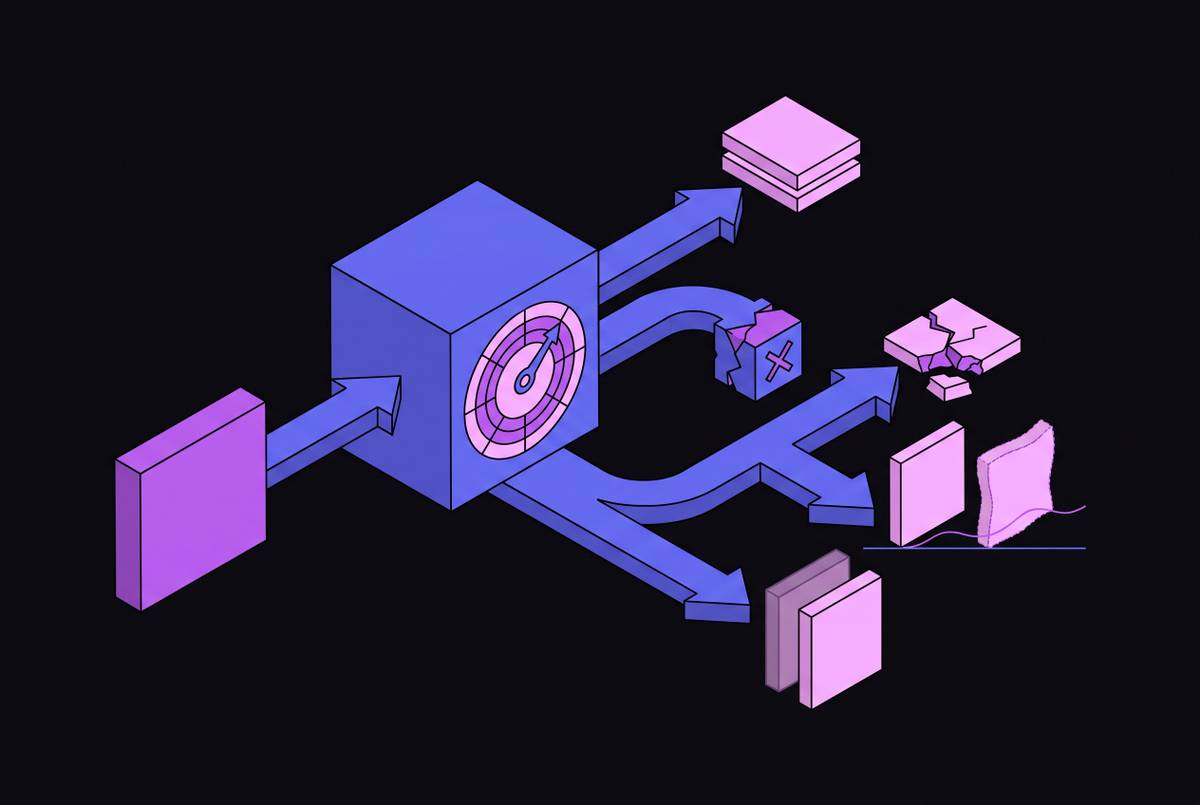
Confidence-gated routing turns the oversight posture into three decision tiers. Auto-approval applies when both judges agree and confidence is high, allowing the output to move downstream without human contact. A disagreement or confidence below the threshold sends the output to the annotation queue. Low confidence in a high-stakes safety, policy, or compliance context instead triggers immediate escalation to a senior reviewer.
The threshold controls how selective that routing becomes. An excessively high confidence requirement sends routine cases to humans and defeats automation. An excessively low requirement lets errors pass without scrutiny. Historical reviewer decisions provide the basis for calibration, rather than treating the threshold as a fixed property of the judge.
Velt's review layer guide names threshold calibration as the key choice in deciding which cases can go through on their own and which are uncertain or high-stakes. For agent evaluations, that decision also needs the right unit of review. A reviewer needs different context for a disputed task outcome than for a disputed tool call, even if both come through the same confidence gate.
The gate also needs an independent check. A small random sample of auto-approved outputs should go to reviewers with no further filtering. This sampling can reveal failure modes that both judges miss and that disagreement routing, by definition, cannot detect on its own.
Designing review interfaces that produce usable signal rather than rubber stamps
A correctly routed output can still produce a useless human label. If the interface shows the automated verdict before the reviewer forms an assessment, anchoring can turn oversight into “rubber-stamping.”
Laura Dietz's Human-in-the-Loop Nugget Annotation for Accountable LLM-as-a-Judge Evaluations proposes a different division of labor. Humans decide which nuggets of information matter for judging system outputs before they see AI scores, while LLMs match those nuggets to large numbers of system outputs. Independence is built into the work sequence.
The interface should present the output and rubric before revealing judge scores. Structured forms with explicit criteria reduce avoidable differences between reviewers, while captured reasoning makes a final label useful for calibration. Once the independent assessment exists, the automated verdict can become part of the review record.
Audit trails serve a separate accountability function. Recording the automated verdict, reviewer decision, and timestamps supports compliance requirements and makes drift visible over time. Calibration sessions address inconsistent application of the shared rubric before that inconsistency enters the feedback loop.
Closing the loop and feeding reviewed disagreements back into judge calibration
Reviewed disagreements become a reliability investment only when their labels reach the judge. Without that connection, the same misalignments recur and the queue remains an annotation expense.
A defined sample of reviewed cases provides a calibration checkpoint. Cohen's kappa between judge scores and human scores shows whether their agreement has fallen below the chosen threshold. Such a drop calls for revising the judge prompt rather than sending individual outputs through another round of review. The cohort identifies a calibration problem that isolated verdicts cannot resolve.
Confirmed failures also belong in the offline evaluation dataset as regression cases that test future model or prompt changes. Human and automated scores can then inform CI/CD quality gates before improvements return to production.
Judge versioning makes these comparisons interpretable over time. Editing a prompt without recording its version makes month-over-month kappa comparisons meaningless because the evaluated judge has changed. Treating judge versions like code preserves that distinction.
As calibration improves, previously seen failure patterns should generate fewer flagged disagreements. A queue that never shrinks signals that labels may not be reaching the judge. Each reviewed case can then make the next cycle cheaper by correcting a recurring misalignment and preserving a test for its return.
Keeping the automated pipeline moving while review is in progress
In an asynchronous design, the annotation queue runs in parallel with the automated pipeline. Auto-approved outputs move downstream immediately, while flagged outputs wait for review. The review dependency applies only to the contested case.
This separation also governs how results reach downstream consumers. Automated scores arrive immediately for approved cases, and reviewed scores arrive when the queue processes the contested cases. Calibration updates occur after a defined sample of reviews.
Velt's review layer guide describes tiered review as a way to keep routine decisions automated and unblocked while reserving manual approval for uncertain or high-stakes outputs. The number of cases in the queue gives an early warning when that separation is under strain. If arrivals outpace reviewer throughput, the routing threshold needs reassessment against historical decisions rather than an automatic expansion of reviewer capacity.
The strongest objection is that automation can still send bad outputs downstream. That risk does not disappear with asynchronous review. Auto-approved cases are the ones on which judges agree with high confidence, where the expected error rate is lowest, but agreement is not proof. Random sampling checks that assumption, while disputed cases go through review and urgent high-stakes cases go to escalation.
What production agent traces add to the routing problem
An agent trace can contain several different objects of disagreement. Judges may dispute a tool call, a handoff between agents, or the final task outcome. Routing only the final answer can omit the evidence needed to resolve a local failure. Routing an entire trace for a narrow tool-call dispute can instead burden the reviewer with context unrelated to the decision.
Span-level and trace-level scoring therefore need their own routes to review. A disputed tool call goes to a reviewer with context about that tool's expected behavior. A disputed task outcome goes to someone who can assess the full trajectory. Reviewer context must match the contested unit.
An agent can return a success code while fabricating an identifier or violating a policy, leaving both judges in agreement that no error occurred. The routing signal is absent despite a substantive failure. Auditing traces against the agent's own instructions can identify such violations in the traces without requiring teams to predefine every failure mode.
Those findings can enter the same review and regression loop as evaluation cases, allowing review to explain past traces and improve future checks. Alerts in Slack and connections to coding agents place contested cases in the developer's existing workflow, avoiding a separate monitoring console that may be bypassed under time pressure.
Where human reviewers are not the right answer to disagreements
Two judges can show high test-retest consistency while sharing position bias, length preference, or same-family circularity. Their agreement leaves the routing queue empty even as systematic error propagates. Reviewing cases one at a time leaves that shared cause in place.
Dietz's paper identifies circular evaluation as a structural problem when generation and evaluation share the same approach. Agreement between the generator and judge family can reflect shared bias rather than satisfaction of the user's information need. More consistent scoring does not resolve that defect. The judge architecture requires attention, even when the system produces few disagreements.
Human labels also need their own consistency layer. Reviewers will not always agree, and exposure to the same rubric does not make them an infallible ground truth. Structured interfaces, calibration sessions, and senior adjudication reduce that variability. Kili's guide identifies adjudication by a senior reviewer as a standard workflow component for resolving disagreements between reviewers.
The appropriate intervention depends on the level of evidence. A contested individual case calls for human judgment, while a cohort-level drop in judge-human kappa calls for rubric or judge-prompt revision. Known shared bias requires an architectural response. Disagreement routing adds the most value when ambiguity is stochastic and case-specific, while its accumulated review data exposes systematic problems at the cohort level.