Inter-Rater Reliability Metrics for LLM Judge Pipelines
Choose chance-corrected metrics over exact match to validate LLM judges fairly.

Inter-rater reliability metrics for LLM judge pipelines must separate accurate judgment from accidental agreement and repeatable error. Exact match cannot make those distinctions. A production pipeline that can be trusted uses chance-corrected agreement that fits its labels and raters, measures the human baseline, and checks how consistent the judge is before using its scores as evidence.
Why exact-match agreement produces a structurally misleading picture of LLM judge quality
A judge can agree with human labels without distinguishing good responses from bad ones. If most items in a dataset are labeled “tie,” a judge that always chooses “tie” will achieve a high match rate. That result reflects the prevalence of the label. Exact-match agreement counts every label that matches as a correct judgment, even when the match is expected by chance. It therefore gives credit for a property that the validation process should discount.
Reliability without Validity found that exact match overstated agreement across every judge and benchmark tested in its 2026 study. A pipeline that selects judges on exact match alone can therefore reward label-distribution mimicry while failing to reward accurate judgment. Those properties are orthogonal, even when they produce similar headline scores.
What Cohen's κ actually measures and when it is the right tool
Cohen’s κ asks how much two raters agree beyond what their own label frequencies would predict by chance. It starts with the observed agreement, then discounts the agreement expected if each rater assigned labels independently according to its own base rates. A judge that just copies the label distribution gets a κ near zero, however high its raw match rate is.
That distinction can change which judge a team selects. Reliability without Validity calls the gap between raw agreement and Cohen’s κ “kappa deflation” and reported a gap of 33–41 percentage points on MT-Bench. The same 2026 study found that switching from raw agreement to κ shifted judge rankings by up to 14 positions across benchmarks. Metric choice is therefore part of system selection.
Cohen’s κ is the appropriate tool when there are two raters, complete overlap, and categorical labels such as pass/fail or compliant/non-compliant. In that setting, one rater can be the LLM judge and the other the human gold standard. A κ below 0.6 is a common production alert threshold, although the appropriate floor depends on task stakes and rubric granularity. Its limits become important as soon as the annotation design grows more complex. Unweighted Cohen’s κ handles only two raters, treats labels categorically rather than by meaningful distance, and does not accommodate missing data.
When the label scale is ordinal: weighted kappa and what it adds
An ordinal rubric makes the size of a disagreement meaningful. On a 1–5 scale, a judge assigning 2 when a human assigns 3 makes a smaller error than a judge assigning 5. Treating both mismatches as equally wrong discards information the rubric was designed to express. Weighted kappa retains that information by applying a distance penalty to disagreements. Larger mismatches count more heavily than smaller ones.
The penalty must fit how much errors cost in the task. Linear weighting penalizes each additional step equally, while quadratic weighting penalizes large disagreements disproportionately. Quadratic weighting is appropriate when a large error is operationally much worse, such as scoring a safety violation as fully compliant. The team must decide whether that distinction holds before choosing the weights.
Haldar and Hockenmaier’s EMNLP 2025 paper tested SummEval’s 1–5 coherence, consistency, fluency, and relevance dimensions and found widespread intra-rater inconsistency. A weighted kappa computed from a single judge run can therefore give a misleading account of judge–human agreement if the judge changes its scores across repeated runs. Its self-consistency must be established before that comparison is trusted. For continuous scores, weighted kappa, score correlation, or mean absolute error may fit, depending on the bounds of the scale and how the scores will be used.
Why Krippendorff's α is the recommended primary metric for most production judge pipelines
Production gold sets often do not fit the complete, two-rater design required by the kappas. Multiple annotators may contribute labels, with individual annotators scoring only some items. Krippendorff’s α accommodates those ragged annotation matrices without imputation. It also works with nominal, ordinal, interval, and ratio scales when the distance functions fit those scales. Because it handles these cases, it is the recommended primary metric for most production judge pipelines, especially those that use multi-annotator gold sets or non-binary rubrics.
Haldar and Hockenmaier recommend Krippendorff’s α for measuring an LLM judge’s self-reliability across repeated runs. Their recommendation rests on its support for varying numbers of annotators, missing data, and different distance functions. The underlying measurement can thus serve both repeated-run consistency checks and comparisons involving human raters.
Other measures can still add useful information. A multi-judge validation study using Claude Haiku 4.5 and another model reported Krippendorff’s α of 0.627, Spearman ρ of 0.602, and binned weighted Cohen’s κ of 0.651. Those results triangulate agreement and score ordering. The practical default is α, with a kappa added when a familiar benchmark helps the team interpret results. Cohen’s κ remains sufficient when a complete two-rater categorical design makes it exactly the right tool.
The human baseline problem: why the ceiling you're calibrating against is lower than assumed
Chance correction does not make human labels an unquestionable standard. Judge–human agreement must be interpreted against the agreement humans achieve with one another on the same task. That baseline is often lower than teams assume, so a moderate judge score may be close to the human ceiling. But a score close to a weak human baseline does not show that a judge is fit to make a high-stakes decision. The reference itself needs measurement.
Anik Jha’s 2026 annotator-pool audit found that expert and crowd annotators disagreed on roughly a quarter of the items each pool independently called unanimous. The audit also found that LLM judges tended to judge more like crowd annotators than experts. A judge–human score consequently depends on which humans supplied the labels. Pool composition is a hidden variable unless that choice and its baseline agreement are made explicit.
Before tuning a judge, teams should compute human inter-annotator agreement using Cohen’s κ for two raters or Krippendorff’s α or Fleiss’ κ for more. In the Hugging Face LLM-judge workflow, human-to-human agreement was 0.563 at first, and the judge later reached 0.843 against those labels. That comparison shows why the human “ceiling” is an interpretive baseline rather than a literal upper bound on a judge’s measured score. A study of three certified psychiatrists using a calibrated rubric found inter-rater reliability, measured with ICC, ranging from 0.087 to 0.295, illustrating how weak that baseline can be even in a high-stakes setting.
Test-retest reliability as a consistency check that requires no human labels
Test-retest reliability measures how well a judge agrees with itself when it runs on the same inputs more than once. It is the cheapest available validation check and can expose instability before a team invests in annotation. A judge can return the same wrong verdict every time. High self-agreement therefore cannot establish validity.
Reliability without Validity found two judges used in production that had test-retest reliability above 0.95 and severe position bias above 0.10. Their preference for the first-shown answer was “highly reproducible but not valid.” Repeating the judgment reproduced the bias rather than correcting it. This is the central limit of the protocol, because a reassuring consistency score can describe a dependable failure. Repetition must not be mistaken for independent evidence that the verdict is sound.
Haldar and Hockenmaier found that setting temperature to zero hurt agreement with human judgment, trading calibration for repeatability. They also found task-dependent limits in newer and larger models, with Qwen 3 approaching the commonly accepted threshold of 0.8 on SummaC but falling well short on more complex tasks such as MT-Bench. Run test-retest first with multiple runs at non-zero temperature, and assess position bias before annotation spend, but follow it with agreement measurement against a human gold set.
How to choose among these metrics for a given pipeline and task type
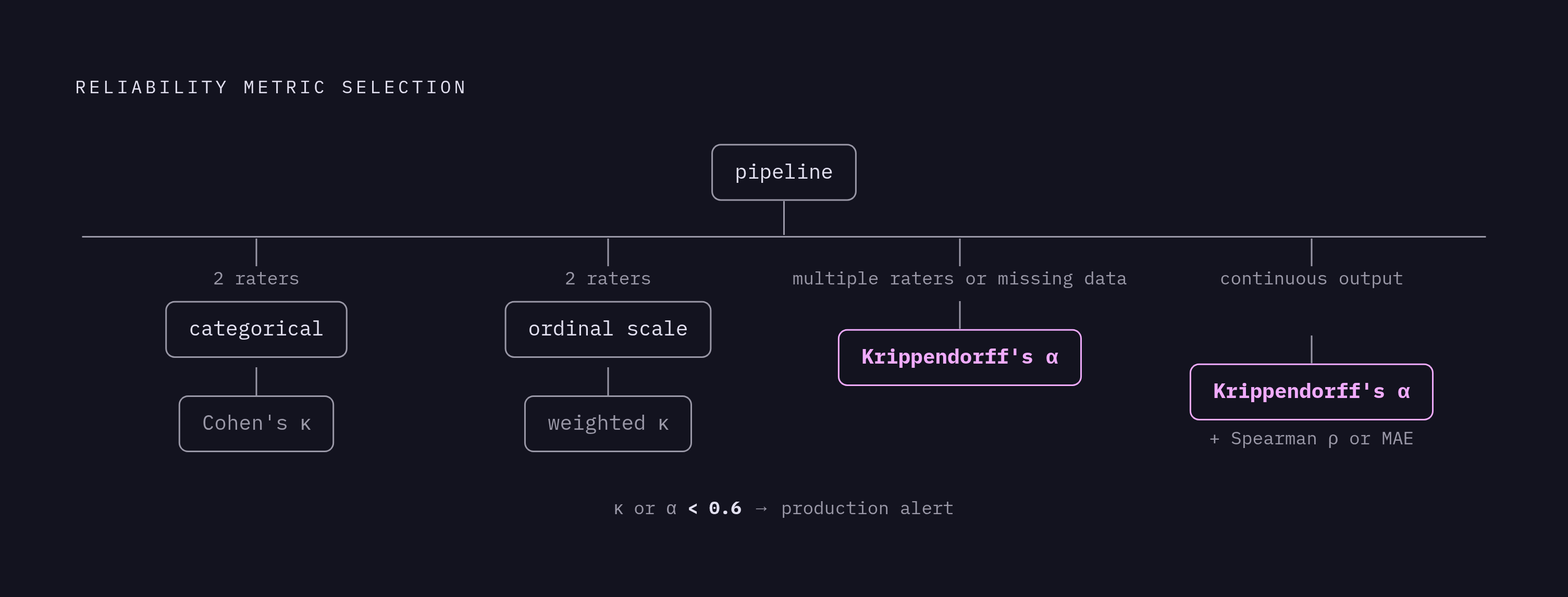
Metric selection follows three properties of the pipeline, namely the number of raters, the output scale, and annotation completeness. For two raters assigning categorical labels to the same items, Cohen’s κ is sufficient and interpretable. If those same raters use an ordinal scale, weighted Cohen’s κ captures the distance between their scores. The choice follows the rubric’s operational meaning.
When there are multiple raters or missing annotations, Krippendorff’s α becomes the primary measure. Its support for different scales also makes it a suitable default when the pipeline extends beyond categorical outputs. Cohen’s κ or Fleiss’ κ can accompany it when stakeholders need a familiar benchmark. For continuous outputs such as 0–1 reliability scores, supplement α with Spearman ρ or mean absolute error to distinguish rank ordering from the magnitude of disagreement. These additions answer separate questions, so the full stack is not required for every task.
The rater design matters as much as the metric applied to it. CM-LRS uses in-panel judges, Sonnet and GPT-5.5, and out-of-panel judges, Haiku and Gemini, to control for self- and family-bias. That architecture makes the source of judgments part of validation rather than treating all judge comparisons as interchangeable. Before constructing such comparisons with human labels, test-retest provides a go/no-go gate for annotation spend.
Running IRR measurement as a continuous production signal, not a one-time calibration check
A launch-time calibration establishes a baseline. Model updates, changes in task distribution, and silent changes to the rubric can all change inter-rater reliability. The judge can keep returning scores through all of these changes. Like silent agent misbehavior, judge drift can preserve the appearance of successful execution while degrading downstream decisions. An error monitor cannot substitute for measurement of judgment quality.
Production thresholds should therefore be explicit and tied to each rubric. A κ or α below 0.6 should trigger rubric review before the judge is trusted with new decision-making, with the appropriate floor adjusted to task stakes. A CI gate can fail deployment when a rubric drops meaningfully from its baseline or falls below its agreed absolute floor. Judge–human IRR belongs among those tracked rubric properties, rather than leaving the gate dependent on raw score outputs.
Multi-step agent pipelines also require per-step IRR tracking. A judge may drift when scoring tool-call quality, response faithfulness, or both, while an aggregate pipeline score conceals the affected dimension. Tracking agreement at each evaluation step makes that drift possible to localize. Continuous IRR measurement is therefore an engineering responsibility.
Sources
- Reliability without Validity: A Systematic, Large-Scale Evaluation of LLM-as-a-Judge Models Across Agreement, Consistency, and Bias
- Rating Roulette: Self-Inconsistency in LLM-As-A-Judge ...
- Capital Markets LLM Reliability Score (CM-LRS): From Plausible to Bankable
- Proceedings of the 9th Widening NLP Workshop, pages 251–267