Self-Consistency Checks as a Lightweight Alternative to LLM Judges
Sampling agent outputs reveals instability without importing a judge's bias or rubric interference.
Self-consistency checks offer a lightweight alternative to LLM judges for detecting behavioral drift and unstable reasoning, but they do not establish correctness. Intent-aware auditing for AI agents must check what the agent does against its original instructions as well as test whether repeated runs agree. The practical approach pairs sampling with instruction-based trace analysis, structural validators, and selective semantic review, assigning each check to the failures it can detect.
Why LLM judges are shakier than most eval pipelines assume
An LLM judge adds a second source of variance to an evaluation pipeline. The agent gives an answer, and another model decides whether that answer meets a standard. Haldar and Hockenmaier (EMNLP 2025) show that judges have low intra-rater reliability across runs with identical prompts and hyperparameters. Their scores can change even when the evaluated material and evaluation conditions do not. As a result, a score change need not mean that the agent’s behavior changed.
Haldar and Hockenmaier find that turning off sampling keeps scores the same but makes them agree less with human judgment. Tiwari (2026) exposes the same distinction from another direction, finding exact repeat agreement well above 90% for both LLaMA-3-8B and Qwen2.5-7B despite low correlation with human scores. A repeatable verdict is therefore not necessarily a trustworthy verdict. Stability can conceal a systematic error just as variability can obscure a real improvement.
The choice of model and rubric adds further uncertainty. JUDGE-BENCH (Bavaresco et al., 2025), spanning 20 NLP tasks and 11 models, finds substantial variance across models and datasets. Yu et al. (2026) find that jointly evaluating multiple rubrics introduces rubric interference, where a verdict shifts depending on which other rubrics appear with it. Only about a third of samples receive fully consistent verdicts under varying rubric sets. These findings separate two questions that an evaluation pipeline must keep distinct: whether an instrument repeats its verdict and whether that verdict is correct.
What self-consistency sampling actually measures, and what it does not
Self-consistency sampling measures repeatability by running the model under evaluation independently several times with the same prompt and measuring how much the outputs agree. High agreement means that the model reliably produces the same answer or behavior. Low agreement exposes variation that a single run would hide. Neither result, by itself, establishes whether the output satisfies the task.
This makes self-consistency a signal of the originating model’s uncertainty. It avoids importing another model’s biases and rubric-composition instabilities into the measurement. It also removes the need to add a separate judge, though generating outputs more than once still adds inference cost. Teams can examine how much the agent varies without first deciding whether to trust another model’s score.
That distinction sets a hard limit on the technique. Tiwari’s finding that stable judges can disagree with people applies equally to the agent being evaluated. Fabricated identifiers, learned policy violations, and hallucinated prices can all repeat without variation. In those cases, a high agreement rate describes the persistence of the failure.
Conversely, a drop in agreement can flag behavioral drift between deployments, divergent reasoning or planning, and unstable output formats. That variation may depart from what the agent was instructed to do. Lemma audits agent traces in real time against those instructions, providing an intent-based check that can be paired with the sampling signal. This pairing distinguishes a change in repeatability from a deviation in behavior. It also gives coverage where conventional error monitoring or sampling alone would leave a silent failure unexamined.
The production failure modes self-consistency is well-positioned to catch
A working taxonomy of agent failures includes planning errors, tool errors, retrieval errors, reasoning errors, and safety and policy violations. Self-consistency applies most directly to planning and reasoning errors because repeated runs can expose divergent trajectories through a task. An agent may come to different conclusions or follow different plans without raising a conventional error. Sampling makes that instability visible across runs.
The competitive pricing data agent illustrates why output structure also matters. Its target sites updated their HTML mid-run, and no error was raised. A structural-change consistency check comparing expected output schema across runs would have flagged the deviation immediately. The important evidence was the departure from the expected structure.
The vendor pricing agent illustrates a related failure inside the workflow. It had silently stopped ingesting PDF content and was hallucinating prices from surrounding context. The agent “succeeded end-to-end from a surface perspective”. A trace-sourced consistency check over the extraction step would have caught the regression. Checking only the final answer would miss the relevant evidence if the fabricated prices remained stable.
These cases define the boundary as much as the opportunity. Comparing reasoning trajectories is a sampling task, while checking that extraction, retrieval, or tool use meets its requirements calls for structural validation. A trace-level auditor, such as Lemma, compares agent outputs against the agent’s own instructions and adds coverage for regressions in extraction, schema adherence, and retrieval. It combines distinct checks so that the failure of an intermediate step is not hidden by a plausible final response.
The failure modes LLM judges can catch that self-consistency cannot
Independent semantic judgment addresses failures that repeatability cannot reveal. A judge can examine whether reasoning is sound, whether an output contains a subtle hallucination, or whether an action violates a nuanced policy. A consistently fabricated identifier may look stable to a sampler while remaining objectionable to an evaluator applying the task’s requirements. This is the strongest case for retaining LLM judges selectively.
Self-consistency measures variation in the agent, while a judge attempts to evaluate the substance of its behavior. The first lacks an independent standard of correctness, and the second brings its own reliability problems. Combining them broadens coverage but does not automatically validate either instrument. A judge still needs evidence that its decisions track the human judgments relevant to the task.
Some failures also call for a third kind of check. The AppWorld benchmark found that false-success signals accounted for the large majority of failures in agent architectures that make explicit completion claims. No LLM judge configuration exceeded AUROC 0.54 at separating false successes from genuine ones. A lightweight TF-IDF detector substantially outperformed those judges. That result supports using a task-specific detector for this failure type, but it does not show that text-based detection can replace semantic evaluation in general.
An agent’s claim that it finished is not itself proof that it completed the required work. Repeating that claim still leaves it unproven, and a judge asked to check it may still fail to tell genuine completion from false success. The AppWorld result therefore rules out a simple choice between sampling and judges. Coverage depends on the evidence a check uses and the failure it is designed to identify.
How do you instrument self-consistency to audit agents against their instructions?
The implementation starts with a frozen golden test set of representative input/output pairs. Run it automatically on every deployment and on a regular schedule, with alerts on pass-rate degradation. Self-consistency extends that baseline by making agreement across samples a first-class metric. The expected outputs still show how well the agent does the task, while repeated runs show how much it varies. Keeping those signals separate stops a failure that repeats from being counted as a pass.
Offline and online evaluation serve different purposes. Offline evaluation runs against a versioned dataset on every PR, with regressions failing the build through a CI gate. Online evaluation runs against sampled live spans, where changes in score distributions flag behavioral drift. The online detector looks for changes in live behavior that the reference set may not expose.
The main measures are the output agreement rate across N samples, the schema consistency of structured outputs, and the trajectory agreement in multi-step planning tasks. Start conservatively with a handful of samples to detect gross instability. Output agreement addresses answer variance, while trajectory agreement addresses differences in how the agent approaches the task. Schema consistency adds evidence about format stability, but structural validators are still needed to establish adherence to the required schema. Each metric should retain its own meaning rather than being treated as another name for correctness.
This arrangement is lightweight because it does not require a separate judging model. Multiple samples from the existing model still consume inference, and the saving is the absence of another model’s licensing cost, integration complexity, and rubric interference. That is a practical advantage when the immediate question is whether a deployment has changed the agent’s behavior.
Production auditing links those measurements to the original instructions and the traces they came from. Within that workflow, Lemma audits every trace against the agent’s own instructions and automatically groups deviations into actionable issues. Self-consistency score drops across traces can feed its alerting and grouping layer without requiring teams to predefine every failure mode or switch to a separate monitoring console. Slack alerting and coding-agent integration connect the findings to the engineering workflow.
Where self-consistency belongs in a layered reliability stack
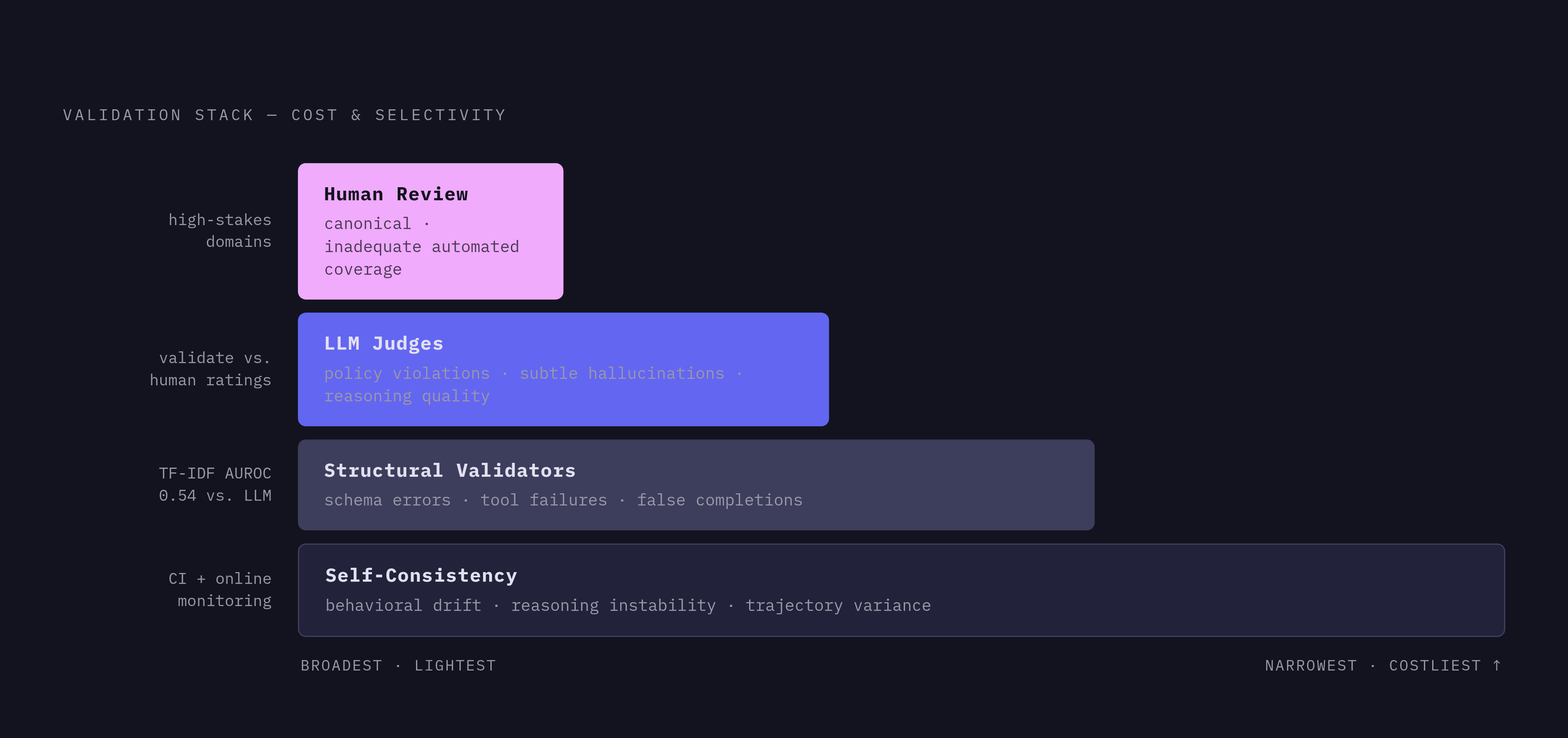
A layered stack assigns each instrument a bounded responsibility. The first layer uses self-consistency to catch behavioral drift, reasoning instability, and trajectory variance across runs. It works in both CI and online monitoring without the need for a separate evaluator model. Its agreement scores are evidence about stability. This makes it a lightweight first layer where instability is the failure signal of interest.
The second layer uses structural and deterministic validators for tool errors, schema violations, retrieval failures, and false completion claims. These checks test requirements that repeated answers cannot establish. The AppWorld TF-IDF finding illustrates how a lightweight non-LLM detector can outperform judges on a specific failure type. An observability layer such as Lemma can bring consistency signals and instruction-based trace auditing into the same production workflow.
The third layer reserves LLM judges for questions that require semantic judgment, including nuanced policy violations, subtle hallucinations, and open-ended reasoning quality. JUDGE-BENCH recommends validating judges against human ratings before trusting them. Use holistic rubric scoring rather than pairwise win-rate for more trustworthy verdicts, and avoid joint multi-rubric evaluation without interference mitigation. These constraints narrow the judge’s remit to work that warrants its cost and uncertainty. They also prevent a general-purpose score from becoming the sole release criterion.
The fourth layer keeps human review for high-stakes domains and types of failure where automated checks are not reliable enough. The PHMForge case shows that human SME consensus remains canonical for difficulty assessment in expert domains. Human review therefore provides a reference where neither sampling nor model judgment is adequate. Its place in the stack depends on the consequences of error and the limits of the available checks.
The practical decision begins with the failure that would most damage users if it went undetected. Use self-consistency when the concern is unstable behavior, structural validation when the concern is unmet execution requirements, and a validated judge when the concern requires semantic interpretation. Use human review when the stakes or the remaining reliability gap demand it. Prioritize catching the most consequential failure, then extend coverage. Do not begin with the most expensive instrument and work downward.
Sources
- Rating Roulette: Self-Inconsistency in LLM-As-A-Judge ...
- When Consistency Does Not Mean Reliability: Evaluating Local LLM Judges Against Human Ratings
- Mitigating Rubric Interference in LLM Judges via On-Policy Self-Distillation
- LLMs instead of Human Judges? A Large Scale Empirical Study across 20 NLP Evaluation Tasks